 Skip to content
No products added!
Category
Date Posted
May 8, 2026
/
No Comments
A Step-by-Step SWOT Analysis Guide for Fast Business Assignments
When a business assignment is due in three hours, students often waste time overthinking strategy instead of organizing ideas quickly. SWOT analysis offers one of the fastest ways to turn scattered research into a structured business evaluation.
This article explains how to conduct and write a SWOT analysis for business case study assignments effectively even under tight deadlines using a step-by-step strategic framework.
Struggling to complete a business case study before the deadline? Our academic writing service provides professional academic writing support for SWOT analyses, case studies, and business assignments under tight deadlines.
What is SWOT Analysis?
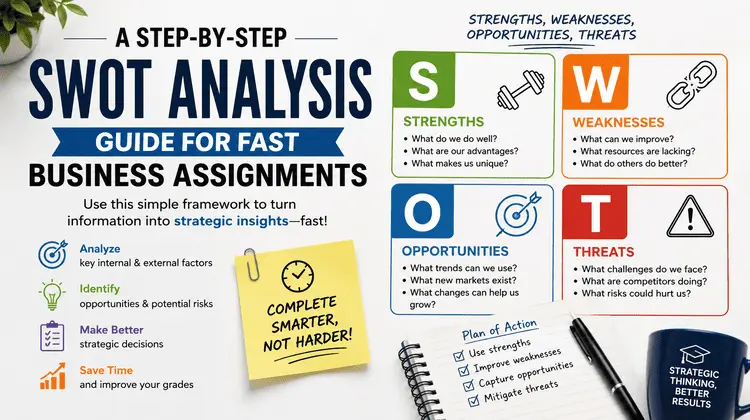
SWOT analysis is a strategic planning tool that evaluates an organization’s strengths, weaknesses, opportunities, and threats. Strengths and weaknesses focus on internal organizational factors. Opportunities and threats examine external environmental conditions (Nickols, 2020).
SWOT analysis is widely used for strategic planning and decision-making. It is often the highest-ranked and most frequently used strategic planning technique. It supports organizational development by identifying:
- Current organizational problems
- Future risks and challenges
- Performance barriers.
Managers use SWOT analysis to:
- Develop strategies
- Implement decisions
- Manage organizational change
- Evaluate performance outcomes.
SWOT analysis helps solve issues related to:
- Technology
- Skills
- Knowledge
- Organizational culture
- Work processes
- Performance management
SWOT analysis utilizes a 2×2 grid to organize strategic factors. At the level of any organization, the implementation of SWOT involves asking questions such as the following in this SWOT analysis template:
Strengths:
| Weaknesses:
|
Opportunities:
| Threats:
|
Stages to follow in SWOT analysis
- Determine your objective
Narrow your focus to a specific goal or decision, such as launching a new product.
- Search for resources
Gather data sets and evaluate the reliability of collected information. The depth of the information helps internal insights and a solid grasp of market forces.
- Compile internal and external factors
Brainstorm any factors likely to impact the organization’s goal or decision. Evaluate human assets, financial resources, operational capacities, and brand name to determine internal factors. Consider monetary policies, demographics, market trends, and suppliers for external factors.
- Split the factors into strengths, weaknesses, opportunities, and threats
Categorize the compiled ideas into the four SWOT quadrants. Use the classic 2×2 grid to categorize your factors.
- Clean up the findings
Refine the list of ideas. Filter the less relevant ones and focus on the highest priorities or largest risks.
- Integrate the SWOT analysis into a strategic plan
Synthesize the final categories into the plan of action to address the original objective.
Need help applying these SWOT analysis stages to your own assignment? ScholarlyWritings.com can help you develop clear, well-structured business case study analyses tailored to your instructions.
Challenges of Internal Analysis
- The “Long List” Mistake: listing every perceived strength and weakness can generate an overwhelming amount of data difficult to translate into an actionable strategy.
- Relevance to Competitive Advantage: Organizations should only cover factors that directly impact their competitive advantage and not general traits.
- Contextual Importance: Some attributes are basic requirements rather than true strengths. Baseline necessities for the industry do not qualify as unique competitive edges.
- Comparative Evaluation: It is common to conduct internal analysis in a vacuum. It is vital to measure attributes against the competition to determine if they truly contribute to a superior market position.
- Strategic Filtering: The goal of internal analysis is to identify how specific attributes shape performance in achieving its desired strategic goals.
Challenges of External Analysis
- Cognitive Bias: Analysis often depends on the subjective focus of the strategists.
- Limitations of Cognitive Maps: Personal experience rather than objective data influence the maps.
- Industry Indifference: It is easy to ignore critical economic indicators and market signals that contradict established beliefs.
- Cognitive Inertia: Strategic thinking often remains stagnant and leads to a failure to adapt.
- Organizational Decline: Analysts may fail to overcome mental biases and refresh environmental insights.
Limitations and Future Directions of SWOT Analysis
- SWOT analysis is often criticized for being atheoretical, as it lacks strong theoretical support to validate its framework.
- It provides a snapshot in time, while business environments and organizational conditions constantly change.
- Regular environmental scanning is necessary to keep SWOT analyses updated and relevant.
The future effectiveness of SWOT may depend on:
- Ranking and weighting variables,
- Prioritizing strategies more effectively, and
- Identifying and closing key internal and external gaps.
Pro Tip in Business Case Study Analysis
Do not use SWOT in isolation.
A comprehensive analysis should go beyond traditional SWOT analysis.
If you have time, aim to always integrate SWOT with other research methods such as:
- Desk research
- Literature reviews
- Expert interviews and workshops
- Scenario planning
- Needs analysis
Six Priorities for Balanced Decisions
Beyond SWOT itself, high-quality business case analyses also consider broader organizational priorities.
Balanced decision-making requires one to focus on these six key priorities in business case analysis:
- Risk Management and Communication
- Market Share and Customer Service
- Infrastructure and System Development
- Process and Procedure Improvement
- Workforce Development and Quality
- Long-Term Strategic Positioning
If you are struggling with a business case study, strategic management assignment, or SWOT analysis report, our fast writing help offers customized academic writing assistance designed to help students meet tight deadlines without compromising quality.
Final Thoughts
A SWOT analysis can serve as a bridge between data and decision making. By following this six-step template to learn how to write a SWOT analysis, you can transform a chaotic list of ideas into a sophisticated strategic plan in just a few hours. The best analyses are not necessarily the longest—they are the ones that clearly show a path toward a profitable fit with the environment. Students who master SWOT analysis can complete business assignments faster while producing more strategic and professional evaluations. Students who need additional support with business case studies, SWOT analyses, or strategic management assignments can also explore professional academic assistance from business assignment help.
FAQs
What is SWOT analysis in business assignments?
SWOT analysis is a strategic planning tool used to evaluate an organization’s strengths, weaknesses, opportunities, and threats. In business assignments, students use SWOT analysis to assess internal capabilities and external market conditions in order to develop strategic recommendations and solutions.
How do you write a SWOT analysis quickly for a business case study?
To write a SWOT analysis quickly, start by identifying the assignment objective, gather reliable information, brainstorm internal and external factors, organize them into the four SWOT categories, refine the findings, and connect them to a strategic action plan. Using a structured six-step approach helps students complete business assignments more efficiently under tight deadlines.
What are the common mistakes in SWOT analysis?
Some common SWOT analysis mistakes include creating long lists of irrelevant factors, failing to compare the organization with competitors, relying too heavily on personal opinions, and using SWOT analysis without supporting research methods. Effective SWOT analyses focus only on factors that directly influence strategic performance and decision-making.
Why should SWOT analysis not be used alone?
SWOT analysis provides a useful overview of strategic factors, but it has limitations because it only offers a snapshot of the organization at a specific point in time. For stronger business case study analysis, students should combine SWOT with other methods such as literature reviews, desk research, scenario planning, expert interviews, and needs analysis to create more balanced and evidence-based conclusions.
References
CIPD. (2025, March 7). SWOT analysis. https://www.cipd.org/en/knowledge/factsheets/swot-analysis-factsheet/
Helms, M. M., & Nixon, J. (2010). Exploring SWOT analysis where are we now? A review of academic research from the last decade. Journal of Strategy and Management, 3(3), 215-251. https://doi.org/10.1108/17554251011064837
May 8, 2026