 Skip to content
No products added!
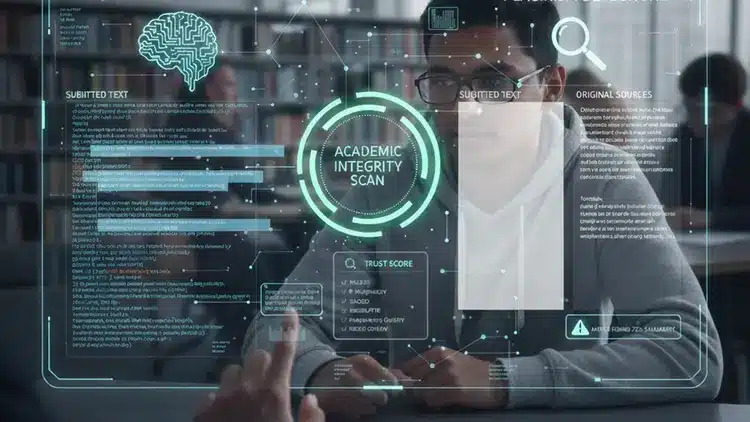
The Evolving Landscape of Academic Integrity
The core principles of academic integrity are facing unprecedented challenges as students and researchers increasingly integrate artificial intelligence (AI) into their workflows. The line between innovation and imitation has never been thinner. At ScholarlyWritings.com, we recognize the significant risks of unintentional plagiarism and ethical attribution that result from the technological advances.
Navigating the complexities of APA, MLA, and Chicago citation styles is a safeguard for your professional reputation. Understanding how to credit intellectual property is particularly essential in this AI age. This guide explores the critical intersection of traditional scholarship and AI technology, providing you with the tools to maintain transparency, enhance your research credibility, and uphold the highest ethical standards of writing.
Navigating Academic Integrity: Citations and Plagiarism in the AI Era
Appropriate citation practices are fundamental to academic writing. Citing serves as the means of acknowledging the intellectual contributions of others, providing evidence to support arguments, and maintaining scholarly integrity. Citations help readers trace the origins of ideas, concepts, and findings to ensure transparency and accountability in research. Attributing sources accurately upholds ethical standards of academic discourse and helps contribute to the ongoing dialogue within a given field.
AI Writing Tools and the Risk of Unintentional Plagiarism
The proliferation of AI writing tools raises new challenges and risks related to plagiarism in academic writing. Undoubtedly, AI tools can significantly help generate content. However, they increase the risk of unintentional plagiarism where AI-generated text closely resembles existing sources without proper attribution. Malicious writers can exploit AI tools to deliberately plagiarize content, violating ethical norms and undermining the integrity of scholarly research.
Maintaining Academic Integrity When Using AI Tools
Maintaining academic integrity in using AI tools requires a proactive approach and adherence to ethical principles. One should familiarize themselves with citation styles and guidelines that academic institutions prescribe. One should ensure one properly attributes all borrowed ideas and sources. In dealing with AI-generated content, critically evaluate and cross-reference it with original sources to identify any discrepancies or cases of inadvertent plagiarism.
Institutional Policies on Ethical AI and Research Frameworks
Universities and academic institutions are developing policies and guidelines to govern the ethical and responsible AI use in response to the rapid advancement of AI tools and their integration into academic practice. Establishing clear frameworks and expectations on transparency and adherence to ethical standards promotes safe, equitable, and ethical AI use within academic settings.
Why ScholarlyWritings.com Prioritizes Academic Honesty
Citing is not just a matter of academic etiquette. It is a legal obligation because plagiarism is a serious offense that can have severe consequences. Citing sources properly ensures one does not engage in plagiarism and one gives due recognition to authors whose work one has consulted.
Enhancing Credibility: How Citations Strengthen Your Arguments
Citing also enhances the credibility and reliability of a written work. Readers can make informed judgments when they see the writer has gathered their information and assess the validity and authority of used sources. Citing conveys that the writer conducted thorough research and deeply understood the topic at hand, which raises the readers’ trust in the writer’s expertise and authority.
Contributing to the Academic Dialogue through Referencing
Citing sources facilitates a dialogue between the writer and the rest of the academic community. The practice proves that the writer engages with ongoing conversations within their field. Referencing other sources situates the writer’s work within a broader context and allows the readers to explore additional perspectives and gain understanding of the subject matter. This way, citing sources promotes intellectual exchange and advances knowledge. Conversely, failing to cite can have negative consequences for the writer and readers relying on their work. Therefore, it is imperative for writers to cite their sources and uphold the highest standards of academic integrity.
Best Practices for Citing Sources and Avoiding Academic Misconduct
Citing sources appropriately is the cornerstone of avoiding plagiarism. Acknowledging the original sources can be through various citation styles, such as APA, MLA, Harvard, or Chicago. Each style has specific guidelines on how to format citations in text and create bibliographies. Following the guidelines meticulously helps students and researchers ensure they give credit where it is due and prevent accusations of plagiarism.
Effective Paraphrasing and Summarizing in Academic Writing
Paraphrasing involves expressing someone else’s ideas or thoughts in your own words without compromising their original meaning. In academic writing, students should reword, restructure, and sometimes shorten the source material in creating a new text that conveys the same essential information. Paraphrasing allows one to incorporate ideas from different authors into one’s work without quoting them directly. It helps avoid plagiarism and conveys a deep understanding of the source material.
Students should first comprehend the source material deeply to paraphrase effectively. The paraphrasing process begins by identifying the main ideas and points that the author tries to convey. The student then puts the information into their own words, using different vocabulary, sentence structure, and examples. Emphasis is on ensuring the paraphrase reflects the original meaning and maintains the author’s perspective. Paraphrasing differs from replacing some words with synonyms or rearranging the sentence structure.
Techniques for Summarizing Complex Scholarly Content
Summarizing entails condensing a larger piece of content into a concise and coherent overview capturing the main points and key arguments. It helps convey a quick and comprehensive understanding of a text. The writer should identify what is important and condense it into a shorter and more streamlined version.
In summarizing, one should first read the entire text to grasp its overall structure and key points. One should then identify key points or evidence contributing to the author’s main arguments. The next step would be to condense the points into concise statements and ensure the summary flows smoothly and maintains a logical progression of ideas.
How to Avoid Plagiarism When Paraphrasing and Summarizing
Paraphrasing and summarizing involve using someone else’s ideas. Therefore, it is essential to cite and reference all sources to avoid plagiarism. Always acknowledge the original source by citing it in the appropriate format. Footnotes, endnotes, or in-text citations are some of the citation methods.
Apart from citing sources, it is essential for the paraphrases and summaries to be truly your own work. This is achievable by avoiding heavy reliance on original text and direct quotes. Instead, express the ideas in your own unique way while maintaining the original meaning. The unique expression demonstrates that the writer understands the source material and helps avoid plagiarism.
Conclusion: Upholding Excellence in the Future of Academic Writing
Ethical standards governing academic writing inherently remain consistent even as AI tools advance. At scholarlywritings.com, we always ensure our citation practices are about acknowledging the intellectual contributions of others to ensure transparency and accountability. Quoting sources is an essential part of academic writing that helps avoid plagiarism, enhance credibility, enhance understanding, support arguments, foster intellectual dialogue, and demonstrate intellectual curiosity.
References
Joshi, K., Singhal, S., & Tandon, A. (2025). Plagiarism in the age of artificial intelligence: A call for ethical vigilance. NMO Journal, 19(1), 1-2. https://journals.lww.com/nmoj/fulltext/2025/01000/plagiarism_in_the_age_of_artificial_intelligence_.1.aspx
January 9, 2026