 Skip to content
No products added!
Category
Date Posted
March 22, 2026
/
No Comments
The 48-Hour Research Strategy: A Masterclass in High-Stakes Academic Writing
We have all observed students spending the week after spring break trying to get over a hangover. I recall the time my friends jokingly insisted that his hangover was the worst in history. I severally questioned whether mine was worth it. I am certain you can relate with the experience many college students face between the final days of March and the awakening of April as they realize that a 3,000-word term paper is due in exactly two days.
The stakes are unprecedent in the 2026 academic landscape as advanced AI-detection benchmarks and “Human-in-the-Loop” grading rubrics render the old “copy-paste” shortcuts no longer viable. You must deliver a sophisticated, evidence-based argument that reflects postgraduate-level critical thinking in your academic writing. Time scarcity forces one to embrace a “research strategist” mindset.
If seeking to learn how our professional academic consultants can deliver high-scoring results under extreme pressure, here is the mechanical, hour-by-hour breakdown of the 48-hour research strategy we follow.
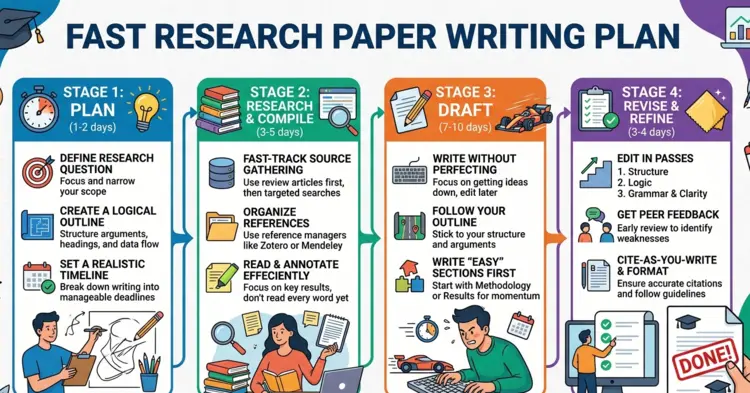
48-Hour Research Strategy — Summary Table
Since you may lack time to even read the entire article, let me first summarize the strategy in a table that you can follow:
Phase
Time (Hours)
Objective
Key Actions
Core Outcome
Phase 1: Tactical Foundation
1–4
Eliminate decision fatigue
– Analyze rubric (action verbs: analyze, evaluate, compare)
– Create 5–7 section outline (“skeleton”) – Draft a working thesis
Clear direction + structured roadmap
Phase 3: Block Drafting (Deep Work)
13–36
Produce high-volume content
– Write body first (not intro)
– Use P.E.E.L. (Point, Evidence, Explain, Link)
– Rewrite AI ideas in your own voice
Full draft with strong academic flow
Phase 4: Data & Technical Accuracy
37–42
Strengthen credibility
– Verify data consistency
– Refine methodology/results
– Use expert help if needed (e.g., SPSS)
Accurate, professional-level analysis
Phase 5: Polished Finish
43–48
Eliminate errors & improve quality
– Reverse outline for clarity
– Read aloud for flow
– Check citations & formatting
Clean, coherent, submission-ready paper
Let me now explain in depth.
Phase 1: The Tactical Foundation (Hours 1–4)
The Objective: Eliminate Decision Fatigue
It is vital to avoid falling into the decision fatigue trap when under pressure. Unfortunately, many waste the first six hours of a deadline “thinking” about what to write. In a 48-hour window, you must have a map to ensure the various choices you have to make do not chip away your mental energy.
- Prompt Deconstruction (The Rubric Audit): The rubric that your professor provides is central in tackling decision fatigue. Start by highlighting the action verbs used. Does the professor require you Analyze, Compare, or Evaluate? It does not matter how well you write if you describe when the prompt required you to evaluate. You would be wrong.
- The “Skeleton” Outline: Create 5–7 subheadings immediately. The skeleton may take time upfront but it pays off eventually by streamlining decision-making. This turns a 10-page monster into five mini-essays of 500 words each. For an MBA or Nursing paper, these usually follow a standard flow: Introduction, Literature Review, Methodology/Case Analysis, Discussion, and Conclusion.
- The Thesis Anchor: Draft a “Working Thesis.” It does not need to be poetic. It just needs to be a claim you can prove.
- Bad Thesis: “Digital transformation in Saudi airports is important.”
Strategic Thesis: “While Saudi Vision 2030 prioritizes digital integration, the sustainability of King Khalid International Airport depends more on facility management optimization than on passenger-facing tech.”
Phase 2: Rapid-Fire Research & "Source Mining" (Hours 5–12)
The Objective: Gather the Fuel
You cannot write from an empty head. However, you also cannot spend ten hours reading entire books. You definitely do not have time for that. The only available path is to “mine” the data.
- The 5-Year Filter: In 2026, information older than 2021 is often considered “stale” in fields like Business, Nursing, or Technology. Set your Google Scholar, ProQuest, and MEDLINE filters to 2021–2026.
- The “Abstract-to-Conclusion” Jump: Professional researchers read the Abstract first. If it’s relevant, they jump straight to the Conclusion and the Results section. If the findings support your thesis, “mine” the bibliography of that paper for three more sources. This time-saving approach is the fastest way to build a high-quality reference list.
The “Quote Catch” Method: As you find sources, copy the relevant quotes and their full citations directly into your outline under the appropriate subheading. By the end of Hour 12, your “blank” document should already be 1,500 words of quotes and notes.
Phase 3: The "Block" Drafting Phase (Hours 13–36)
The Objective: High-Volume Production
This is the “Deep Work” zone. Switch off your phone and ignore your inbox.
- Write the “Body” First: Never start with the Introduction. The Introduction is a promise of what you will do; you do not actually know what you have done until the middle is written. Start with the section you have the most evidence for.
- The “P.E.E.L.” Paragraph Structure: To ensure postgraduate-level flow, every paragraph must follow this:
- Point: Your claim.
- Evidence: The quote you mined in Phase 2.
- Explanation: Your analysis of why that evidence proves your point.
- Link: How this leads to the next subheading.
The 2026 AI-Integrity Guard: Many US universities now use “Style-Metrics” to see if your writing voice shifts. If you use AI to brainstorm, you must rewrite the output in your own voice. Focus on adding “Personal Synthesis”—connecting two different scholars’ ideas in one sentence. This is the “gold standard” of postgraduate writing that AI still struggles to replicate.
Phase 4: Data Synthesis & Technical Accuracy (Hours 37–42)
The Objective: The “Pro” Edge
For MBA, Nursing, or STEM students, a paper is only as good as its data. If your paper requires a quantitative element, this is the make-or-break moment.
- The Data Audit: Does your methodology hold up? If you are discussing heart failure readmission rates or airport efficiency metrics, ensure your numbers are consistent throughout the paper.
Outsourcing the Technicals: If you find yourself stuck on a complex SPSS regression or a specific data visualization at Hour 38, this is the time to leverage expert help. A professional SPSS and Data Analysis service can turn raw data into a polished “Results” section in hours, allowing you to focus on the concluding arguments.
Phase 5: The "Polished Professional" Finish (Hours 43–48)
The Objective: Eliminating the “Procrastination Penalty”
Professors can tell when a paper was finished ten minutes before the deadline because the last three pages are usually full of typos and broken citations.
- Reverse Outlining: Read your finished paper and write one sentence in the margin for every paragraph summarizing its main point. If two paragraphs have the same summary, delete one. If a paragraph does not have a point, fix it.
- The “Read Aloud” Test: Your ears catch errors your eyes ignore. Read your paper aloud. If you run out of breath in the middle of a sentence, the sentence is too long.
The Citation Sweep: Use a tool like Zotero or Mendeley, but perform a manual “spot check.” Ensure every “Et al.” is used correctly and that your Reference List is in perfect alphabetical order. In 2026, formatting is often 10-15% of the total grade.
Conclusion: Turning Pressure into Excellence
Writing a 3,000-word paper in 48 hours is a feat of endurance, but it is also a test of organizational skill. By following this mechanical strategy—Audit, Mine, Block-Draft, and Polish—you bypass the emotional hurdles of writing and treat it like the technical project it is.
However, even the best strategists hit a wall. Whether it is a complex nursing case study that needs a systematic literature search or an MBA capstone that requires deep market analysis, you do not have to go it alone.
At ScholarlyWritings.com, our postgraduate experts specialize in these high-stakes turnarounds. We provide the research depth, data analysis, and technical formatting that transform a “rushed” paper into a “distinguished” one.
Running out of hours? Upload your rubric to ScholarlyWritings.com today and let us handle the heavy lifting while you focus on crossing the finish line.

Need help with research paper writing?
March 22, 2026