 Skip to content
No products added!
Category
Date Posted
May 9, 2026
/
No Comments
Rapid Literature Review: How to Synthesize 10 Sources in One Afternoon
Key Takeaways
- Narrowing the research question using the PICO framework (Population, Intervention, Comparison, Outcome) is the fastest way to improve efficiency and focus.
- Limiting search parameters—such as publication date, language, and study type—helps reduce information overload and speeds up source selection.
- Prioritizing systematic reviews and clinical guidelines before individual studies can save substantial time during the evidence-gathering phase.
- Avoiding grey literature and overly broad database searches minimizes time spent appraising low-value or difficult-to-verify sources.
- The Manuscript Map technique helps eliminate writer’s block by organizing the review into IMRAD sections before writing begins.
- Using PRISMA 2020 guidelines improves consistency, transparency, and completeness in reporting the review process and findings.
- Data extraction sheets help reviewers focus only on the most relevant outcomes instead of reading every article in full detail.
- Mind-to-paper dictation techniques can significantly accelerate drafting while maintaining readability and analytical depth.
- Effective synthesis involves comparing findings across studies, identifying agreements or conflicts, and evaluating the overall strength of evidence.
- With a structured workflow and disciplined source selection, it is possible to synthesize 10 sources into a meaningful literature review within a single afternoon.
Introduction
Whether you are a busy graduate student or a clinician needing evidence-based answers for a practice change, the conventional literature review timeline spanning weeks or months is often a luxury you do not have. A Rapid Literature Review (RR) offers a streamlined alternative—a synthesis of evidence that modifies certain components of the review process to produce high-quality results in a fraction of the time.
While producing a full, publishable rapid review typically takes about three months, the most intensive phase—the synthesis of approximately 10 key sources—can be accomplished in a single afternoon if you use the right framework. This article explores how to synthesize literature review fast without compromising on scientific quality.
The Rapid Review Philosophy: "Quick but Not Dirty"
A rapid review is an expedited review that simplifies or omits non-critical components. Its goal is to move from a broad “search and find” mission to a laser-focused “analyze and apply” session.
To synthesize 10 sources in one afternoon, you must shift your focus from comprehensive searching to strategic selection. For many students and clinicians, the most time-consuming part of a rapid review is not writing, but filtering sources, organizing evidence, and maintaining methodological consistency under tight deadlines. In such cases, services like ScholarlyWritings.com can provide valuable academic support during the review process.
Phase 1: The Foundation (12:00 PM – 1:00 PM)
1. Define a Focused Research Question
The most critical factor in speed is the narrowness of your question. Use the PICO framework to define your scope:
- Population (e.g., children aged 6–12)
- Intervention (e.g., school-based physical activity)
- Comparison (e.g., no intervention)
- Outcome (e.g., impact on daily exercise time)
An example of a PICO question is as follows: Among university students (P), does online CBT (I) compared to no intervention (C) reduce anxiety symptoms (O)?
The PICO model is the most common model for focusing on the issue and outcome of interest, facilitating search, and directing the question clearly.
2. Limit the Search Parameters and Filter Results
To finish in an afternoon, you cannot search every database or review every available study.
- Locate references meeting certain criteria: Filters categorize based on publication type, topic, age group, or other categorizations
- Limit Languages: Focus only on English-language papers.
- Narrow the Date Range: Look for papers published in the last 3–5 years.
- Search for pre-synthesized evidence first: Prioritize systematic reviews or guidelines before looking for single studies.
The PICO framework also helps generate precise and relevant search terms.
Phase 2: The Selection (1:00 PM – 2:30 PM)
3. Rapid Screening and Selection
Your goal is to identify exactly 10 high-quality sources that directly answer your PICO question.
- Rule of Thumb: Your initial search should ideally yield a manageable initial pool of titles, which you can quickly filter down.
- Eliminate “Grey” Literature: Avoid unpublished reports or conference abstracts as they are time-consuming to appraise.
Phase 3: The Synthesis (2:30 PM – 5:00 PM)
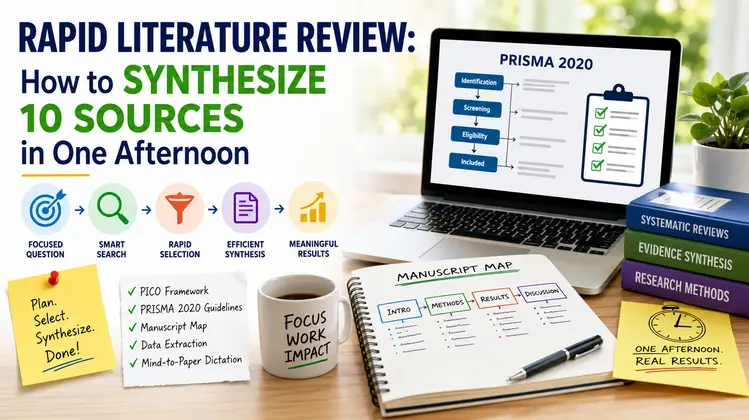
4. The Manuscript Map Technique
Writer’s block is the enemy of the afternoon review. Professional researchers use a Manuscript Map—a detailed outline that serves as a blueprint for the final article.
- Create a document with classic IMRAD headings: Introduction, Methods, Results, and Discussion.
- Under each heading, insert bullet points based on the PRISMA 2020 guidelines for consistency and completeness in reporting included studies.
5. Data Extraction and Mind-to-Paper Dictation
Instead of reading each source cover-to-cover, use a pilot data extraction sheet to pull only the specific outcomes you need. To speed up the writing process, consider the mind-to-paper technique:
- Dictate your observations directly into a smartphone or transcription software.
- Correct the first dictated draft of the manuscript for typos, and after revision, the manuscript can achieve both clarity and analytical depth.
- Focus on the Synthesis: Compare findings across your 10 sources. Do they agree? Where is the conflict? What is the overall strength of the evidence?
Rapid reviews may not achieve the comprehensiveness of full systematic reviews, but they provide timely and practical evidence synthesis for decision-making when under pressure.
Why Use ScholarlyWritings.com?
Synthesizing a literature review requires a high level of academic rigor and an eye for detail. If you find yourself overwhelmed by the technical requirements of bias assessment or PRISMA compliance, ScholarlyWritings.com provides expert support to help you refine your manuscript. Whether you need a second pair of eyes for proofreading or assistance in structuring your data extraction table, professional academic services can ensure your “rapid” review still meets “gold-standard” expectations.
Final Thoughts
With a focused research question, strategic source selection, and a structured synthesis process, you can transform a large body of evidence into a clear and meaningful review within hours instead of months.
If you need expert assistance with source synthesis, PRISMA formatting, data extraction, proofreading, or structuring your literature review, ScholarlyWritings.com offers professional academic support tailored to graduate students and researchers. Whether you are working against a tight deadline or aiming for publication-quality work, expert guidance can help you produce a rapid review that is both efficient and academically rigorous.
FAQs
What is a rapid literature review?
A rapid literature review is a streamlined evidence synthesis method that simplifies certain steps of a traditional literature review to produce reliable findings in a shorter period of time.
How can I synthesize 10 research sources in one afternoon?
You can speed up the process by using a focused PICO research question, limiting search parameters, selecting only high-quality sources, and using structured techniques such as manuscript mapping and data extraction sheets.
What is the PICO framework in literature reviews?
The PICO framework helps researchers develop focused research questions by defining the Population, Intervention, Comparison, and Outcome under study. It improves search accuracy and reduces unnecessary sources.
Can professional academic services help with rapid literature reviews?
Yes. Services like ScholarlyWritings.com can assist with source synthesis, PRISMA formatting, proofreading, data extraction, and overall literature review organization for students and researchers working under tight deadlines.
References
Eriksen, M. B., & Frandsen, T. F. (2018). The impact of patient, intervention, comparison, outcome (PICO) as a search strategy tool on literature search quality: A systematic review. Journal of the Medical Library Association, 106(4), 420-431. https://doi.org/10.5195/jmla.2018.345
PRISMA Statement. (2024). PRISMA 2020 checklist. https://www.prisma-statement.org/prisma-2020-checklist
Rosenberg, J., Fonnes, S., Öberg, S., & Andresen, K. (2022). How to produce a rapid systematic review – A review article. Danish Medical Journal, 69(12), 1-8. https://pubmed.ncbi.nlm.nih.gov/36458606/
May 9, 2026