 Skip to content
No products added!
Category
Date Posted
April 23, 2026
/
No Comments
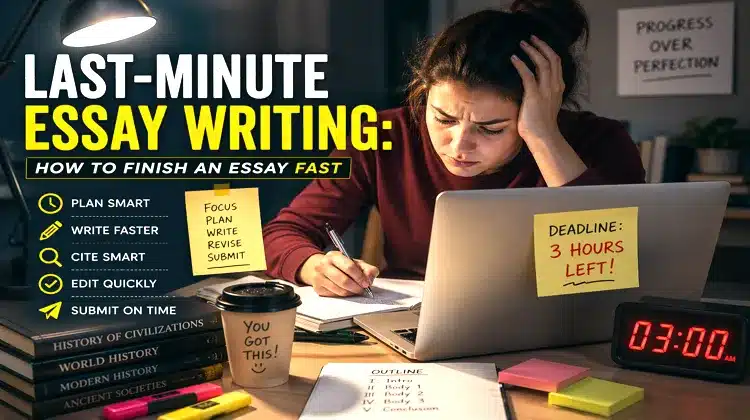
Last-Minute Essay Writing: How to Finish an Essay Fast
Introduction: You are in Emergency Mode—Here’s How to Survive
If your essay is due in less than 5 hours, you are in emergency mode. Last-minute essay writing feels like a relentless, ticking countdown. It is late, your coffee is cold, and the exhaustion has settled into your bones. That assignment due in just a few hours remains a hauntingly blank document.
If you are staring at that cursor, paralyzed between rising panic and the urge to procrastinate, you are not alone. However, you must realize that your biggest enemy tonight is not the looming deadline—it is the suffocating grip of perfectionism.
You do not need to write a flawless masterpiece in the middle of the night. You need a clear, well-structured, and evidence-based submission that meets the rubric and earns the marks you deserve.
This is your ultimate survival guide—a streamlined, step-by-step system designed to move you from total panic to a successful submission.
🧠 How to finish an essay fast under pressure
- Understand the question (5–10 minutes)
- Create a quick outline
- Write body paragraphs first
- Use minimal sources
- Edit quickly and submit
👉 Struggling to finish in time?
Phase 1: The Tactical Reset (15 Minutes)
Before you write a single sentence, you must break the cycle of panic.
1. Stop the Research Rabbit Hole
The “Research Rabbit Hole” is the primary enemy of the ticking clock; endless Googling provides a false sense of productivity while actually destroying your available time.
To regain control, execute a clean sweep:
- close every unnecessary browser tab and silence your notifications.
- Narrow your focus to 2–3 reliable sources
- Prioritize your lecture notes and core course materials.
Remember, your objective right now is not to become a world-renowned expert or discover obscure theories—it is to fulfill the assignment requirements with maximum efficiency and precision.
2. Deconstruct the Essay Prompt
Before you commit to a single paragraph, you must read the prompt with absolute focus—at least twice. Identifying the core instruction is the difference between a high mark and a total restart. Look for the directive verbs that dictate your strategy:
- Analyze → requires breaking concepts into parts;
- Evaluate → demands a judgment of effectiveness;
- Compare → looks for patterns of similarity; and
- Describe → focuses on clear explanation.
If you misunderstand the fundamental question, even the most brilliant writing will miss the mark.
The 15-Second Shortcut: Summarize the entire prompt in one simple sentence. If you can clearly articulate the mission in your own words, you are officially on the right track to a successful submission.
Phase 2: Build a Simple Structure (20 Minutes)
When the deadline is looming, writing without a roadmap leads to rambling, repetition, and lost marks. Instead, spend twenty minutes building a rigid Emergency Essay Outline to serve as your tactical guide:
A lean Introduction (10%)
- Establish context
- A clear thesis statement
Body Paragraph 1
- Main argument + evidence
Body Paragraph 2
- Supporting argument + evidence
Body Paragraph 3
- Additional point or counter-argument
Conclusion (10%)
- Summary of findings
- Final insight
This disciplined structure keeps your writing focused, ensures you hit every requirement, and makes the grader’s job effortless. You need a basic structure.
This structure keeps your essay focused, logical, and easy to follow.
👉 Feeling stuck even at this stage?
Phase 3: The Drafting Blitz (2–3 Hours)
Now is the moment to transform your outline into a complete manuscript—and the key is to write with relentless speed.
Rule #1: Write First, Edit Later
Do not:
- Rewrite sentences repeatedly
- Fix grammar as you go
- Aim for perfection
Instead, get your ideas onto the page as quickly as possible, accepting that your initial sentences will be rough and unpolished:
- Keep moving forward
- Accept rough sentences
- Focus on getting ideas down
Momentum is everything. The goal is to have a finished draft, not a perfect one.
Use the PEEL Method for Speed
Each paragraph should follow:
- Point → Your main idea
- Evidence → Example or source
- Explanation → Why it matters
- Link → Connect back to your argument
This keeps your writing structured without overthinking.
Start with the Body, Not the Introduction
The introduction is often the hardest part.
Skip it.
Write your body paragraphs first—your ideas will become clearer, and the introduction will take minutes later.
Lower the Bar for “Academic Writing”
Trying to sound overly intelligent will slow you down.
Instead:
- Write clearly
- Explain ideas simply
- Avoid complicated wording
If you get stuck, leave a placeholder and move on.
Example:
[Add example about economic theory here]
You can fix it later.
If you are already behind schedule, forcing it may hurt your grade.
Get expert help and submit on time
Phase 4: Handle Sources and Citations (45 Minutes)
Even under pressure, you must maintain academic integrity.
Keep It Simple
- Use 1–3 sources max
- Focus on relevance, not quantity
Follow the “If You Didn’t Know It, Cite It” Rule
If the idea is not originally yours, cite it.
Better to have too many citations than too few.
Use Citation Tools
To save time:
- Use online citation generators
- Follow required style (APA, MLA, Harvard)
Paraphrase Properly
Do not just swap a few words.
Instead:
- Read the idea
- Understand it
- Rewrite it in your own words
This avoids plagiarism and improves clarity.
Phase 5: Write the Introduction and Conclusion (30 Minutes)
Now that your body is complete, finish strong.
The Introduction
- Brief context
- Clear thesis statement
Example:
“This essay argues that [X] occurs due to [Y], supported by [Z].”
The Conclusion
- Restate your main argument
- Summarize key points
- End with a final thought
Keep it simple—no new ideas.
Phase 6: Final Edit and Submission (20 Minutes)
You are almost done—do not rush this last step. These last twenty minutes are where you transform a rough draft into a polished, professional submission. Precision here can be the difference between a high grade and a frustrating loss of marks.
Quick Editing Checklist
- Fix obvious grammar issues
- Remove repetition
- Improve sentence clarity
- Check formatting
Use the “Read Aloud” Test
Reading your essay out loud helps catch:
- Awkward phrasing
- Missing words
- Run-on sentences
Once these boxes are checked, you can hit submit with total confidence.
Final Questions relevant to Last-Minute Essay Writing Before Submission
- Did I answer the question?
- Is my structure clear?
- Does my argument make sense?
If yes—submit.
Done is better than perfect.
⚠️ When Time Is Not Enough
Sometimes, no matter how hard you try, you simply do not have enough time.
Maybe:
- The essay is too long
- The topic is too complex
- You have other deadlines
At that point, pushing through can lead to a poor result—or missing the deadline entirely.
🚀 Get Expert Help Before It is Too Late
If you are running out of time, the smartest move is to get support.
At ScholarlyWritings.com, you can:
- Get urgent essay assistance
- Meet tight deadlines
- Receive high-quality, original work
- Reduce stress and avoid penalties
👉 Do not risk your grade:
Why Students Choose ScholarlyWritings.com
- Fast turnaround for tight deadlines
- Expert writers across multiple subjects
- Plagiarism-free work guaranteed
- Reliable support when you need it most
Instead of struggling through the night, you can focus on what matters while experts handle the workload.
👉 If you are struggling with an essay due in a few hours, we are ready to help.
Final Thoughts: Focus on Completion, Not Perfection
Right now, your goal is not to write the best essay of your life.
It is to:
- Maintain focus
- Follow a clear system
- Complete the essay on time
A submitted essay—even an imperfect one—is always better than an unfinished draft.
And if finishing feels impossible, remember—you do not have to do it alone.
Step 7: Quick Edit Pass (10–20 Minutes)
Now refine:
- Grammar and spelling
- Repetition: Cut the Clutter
- Sentence clarity: Read a few sentences aloud.
- Formatting
Do not aim for perfection—aim for readability. If it is clear, logical, and clean, it is ready to go.
👉 Every minute you hesitate, your deadline gets closer. Get expert help now and submit with
We assure:
✔️ 100% original work
✔️ Delivered on time—even under tight deadlines
✔️ Trusted by students worldwide
April 23, 2026