 Skip to content
No products added!
Category
Date Posted
April 23, 2026
/
No Comments
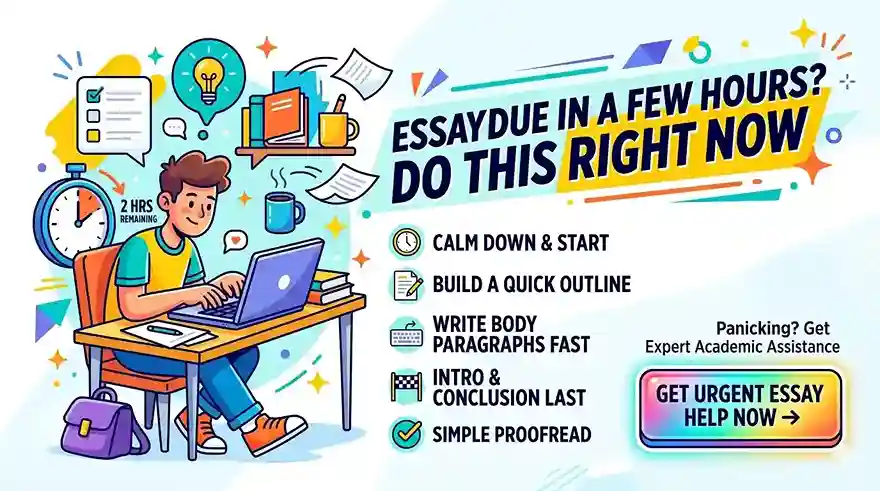
Essay Due in a Few Hours? What to Do Right Now
Introduction: Panic Is Normal—But Not Helpful
If your essay deadline is just a few hours away, you are probably feeling a mix of panic, regret, and pressure. Maybe you forgot. Maybe you misjudged the workload. Or maybe life just got in the way.
Whatever the reason, here is the truth: you still have time to produce a solid essay. However, you need to stop panicking and start working strategically.
This guide breaks down exactly what to do if essay is due in hours. No fluff. No overthinking. Just a clear, step-by-step emergency system to get your essay done fast and effectively.
Step 1: Stop Everything and Understand the Task (5–10 minutes)
Before typing anything, slow down just enough to understand what is being asked.
Read the essay prompt carefully and identify:
- What is the topic or question?
- What is the required word count?
- Which formatting style (APA, MLA, Harvard, etc.) should you follow?
- Which are the submission requirements?
- What does the marking criteria or rubric prioritize?
Ask yourself:
- What is the lecturer actually testing here?
Is it:
- An Argument? They want to see your logic and persuasion.
- An Analysis? They want you to break a complex idea into pieces.
- A Reflection? They want to see your personal growth and insight.
- A Description? They want to see your mastery of the facts.
A clear understanding saves time later by preventing rewrites.
Step 2: Build a Quick Essay Skeleton (10–15 minutes)
You do not have time for perfection. You need structure.
Create a simple outline:
Introduction
- Hook (1–2 sentences)
- Background (2–3 sentences)
- Thesis statement
Body Paragraphs
- Main point
- Explanation
- Evidence/example
Conclusion
- Restate thesis
- Summarize points
- Final insight
Even if it feels basic, this structure prevents chaos.
Step 3: Write the Introduction Last
One of the biggest mistakes students make under pressure is overthinking the introduction.
Instead:
👉 Skip it and write the body first. You will be clear on what you are introducing once your arguments are built and your evidence is in place.
Why?
Because once your ideas are fully developed, the introduction becomes much easier.
A strong introduction is not about complexity—it is about clarity.
Step 4: Write Fast, Not Perfect (60–90 minutes)
Now is the time to get your ideas down. For the next 60–90 minutes, your goal is volume, not perfection.
Rules:
- Do not stop to polish a sentence. If it sounds clunky, leave it and move on.
- Do not over-research. If you are missing a fact, do not spend long on it. Just write another fact and keep going.
- Do not aim for “perfect academic tone”. Write like you are explaining it to a smart friend.
- Keep writing continuously
Each paragraph should follow:
Point → Explanation → Example → Link back
This proven structure helps to keep your logic tight without overthinking it.
If stuck:
- Write a placeholder sentence. Write a “bridge” sentence like: “I need to connect the economic theory to the case study here, but I’ll figure out the wording later.”
- Move forward
- Fix later
If you want more on how to write an essay without losing quality, see this:
Step 5: Use Minimal, Reliable Sources
Avoid research overload.
Stick to the sources that are already at your fingertips. Use:
- Lecture notes: exactly what your lecturer wants to see you apply
- Course textbooks
- 1–3 academic sources max
Avoid:
- Endless Google searches
- Irrelevant citations: Do not add sources just to look smart.
- Overcomplication
At this stage, relevance beats quantity every time.
👉 If you are struggling with an essay due in a few hours, we are ready to help.
Step 6: Write a Clean Conclusion (5–10 Minutes)
Your conclusion should:
- Restate your thesis: (use different words, but maintain the same meaning)
- Summarize key arguments
- End with a final insight showing why this topic matters in the real world
No new ideas. No complexity.
Simple is effective.
Step 7: Quick Edit Pass (10–20 Minutes)
Now refine:
- Grammar and spelling
- Repetition: Cut the Clutter
- Sentence clarity: Read a few sentences aloud.
- Formatting
Do not aim for perfection—aim for readability. If it is clear, logical, and clean, it is ready to go.
Step 8: Final Check and Submit
You have done the research, built the logic, and polished the prose. Now, perform one final “Gut Check” and hit send.
Ask:
- Does it answer the question?
- Is it structured logically?
- Is it easy and clear for the lecturer to read?
If the answer is “Yes,” you are done—submit.
Over-editing at this stage creates new mistakes.
💡 The Golden Rule of Submission
Done is better than perfect. If you have answered the question, backed it up with evidence, and formatted it correctly, you have already won.
Take a deep breath, click submit, and go take a well-deserved break!
When Time Runs Out: What Really Matters
A last-minute essay is not about brilliance—it is about execution under pressure.
Markers look for:
- Clear argument
- Logical structure
- Basic evidence
- Relevance to question
Even rushed essays can perform well if structured properly. Stick to the structure, answer the prompt, and get it across the finish line.
👉 Need urgent help instead of doing it alone? You can get expert assistance here:
Final Thought: You Do not Have to Do This Alone
If overwhelmed or running out of time, getting expert help can be the difference between missing a deadline and submitting a strong paper. Sometimes, the smartest move is knowing when to call in reinforcements.
At ScholarlyWritings.com, we support students with urgent, high-quality academic writing assistance.
If you are under pressure right now
April 23, 2026