 Skip to content
No products added!
Category
Date Posted
May 15, 2026
/
No Comments
AI vs Human Essays: Why Human Writing Is Still More Reliable in Academic Work
Key Takeaways
✓ AI-generated essays can achieve impressive fluency but remain vulnerable to factual inaccuracies and hallucinations.
✓ AI outputs depend heavily on prompt quality and often struggle with deep argument development.
✓ Human writers better understand assignment instructions, logical organization, and proper source integration.
✓ Ethical AI use includes brainstorming, editing support, literature review assistance, and feedback—not replacing authorship.
✓ Human-written papers remain more reliable when assignments require critical thinking, analysis, and academic rigor.
✓ AI is most effective as a productivity tool rather than a substitute for genuine academic writing.
Introduction: Human vs AI in Academic Writing
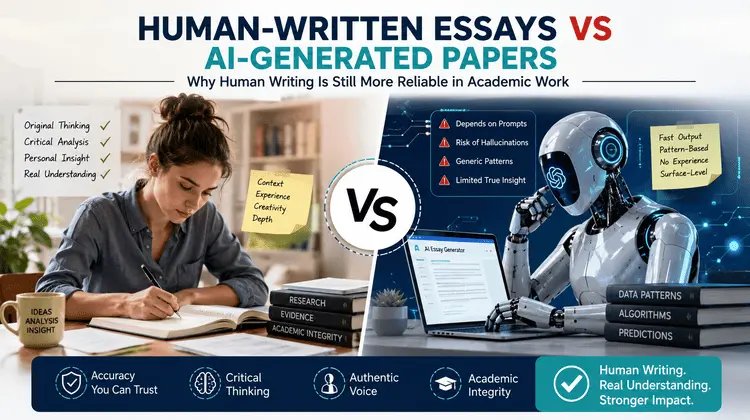
As artificial intelligence (AI) systems become part of modern life, it has become necessary to distinguish between human and AI-generated content. Concerns over authenticity of academic writing being at stake are rising as AI platforms advance to generate highly linguistically and grammatically sound texts.
Humans write content with the intention of reflecting intent. Therefore, their writing is likely to be original and creative. AI-generated content, however, is based on algorithms designed to generate text in response to specific prompts.
Based on these, this article compares the reliability of human-written and AI-generated essays to highlight where this debate heads.
AI-generated Essays: How Modern AI Writes
Large language models (LLM) have transformed over the past five years. Initially, AI outputs were weak in coherence, repetitiveness, and long-range structure. Kujur (2025) noted that AI-generated essays normally contained repetitive phrases without sustained discourse coherence. At the time, it was easy to distinguish AI outputs from human-written papers. The AI-generated essays overly followed more regular and template-like syntactic patterns than human writing.
As the technology keeps evolving, modern LLMs generate text with near-human fluency and discourse strength. There has been a sharp decline in the stylistic gap between LLMs and human writers in academic genres.
However, subtle discrepancies remain as LLMs exhibit more uniform sentence-length patterns and smoother transitions but lack spontaneous personal nuances. Even when LLMs manage to imitate academic tone, they do not exhibit the kind of rhetorical irregularity seen in human writing.
The historical advances are clear with earlier AI-generated essays easily detected because of their structural and coherence limitations but the post-2023 models are extremely sophisticated in imitating human writing.
Human-Written Papers: What Makes Them Different?
Human writing is distinctly personalized. Human-written papers are characteristically variable, emotionally nuanced, and irregular based on an individual’s experience, cognitive pacing, and contextual reasoning (Kujur, 2025). Writers exhibit uneven rhythms and spontaneous narrative digressions that improve their expression and lower their predictability.
As writers weave their experiences and reflections in their memory to make an argument, their writing style fluctuates, tone shifts, and narration reveals occasional redundancy characteristic of human cognition. They integrate field-specific metaphors and their individualized phrasing is unique to their personal knowledge and rhetoric history (Kujur, 2025).
“Human-written papers are irregular, emotionally textured, voice-driven, and rhetorically adaptive—features AI still struggles to replicate.”
Humans also exhibit rhetorical and emotional flexibility. Writers naturally adjust their tone depending on their target audience, purpose, and stance. Some of their emotional stances are unintentional as vocabulary choices unconsciously express individuals’ psychological states. As a result, human writing is irregular, emotionally textured, voice-driven, and rhetorically adaptive (Kujur, 2025). These are the features that LLMs struggle to replicate.
A central feature in writing academic text is the authentic approach to building text around assignment instructions. Humans are better suited to understanding the topic, aligning what they write to instructions, developing paragraphs logically, and using sources and citations accurately.
Academic Integrity and AI
Academicians acknowledge the enormous potential of AI in research applications. However, they also recognize the threats that AI with human-level writing skills pose to academic integrity.
AI is a tool with potential to cause good or harm depending on individual motivations, experience level, and integrity.
Ethical concerns arise regarding the authenticity and credibility of academic work. Relying on AI to write text blurs the line where the completed text becomes fraudulent (Hakam, et al., 2024).
AI often presents false results. Any misrepresentation can lead to confusion, especially when presented to inexperienced peers. Therefore, users should fact-check any AI-generated statement using credible references when relying on AI tools.
The influence of large language models (LLMs) should be restricted to:
- organizing thought processes,
- obtaining feedback,
- editing human-written text, and
- presenting citations in the requested format.
Prompt Dependency and AI Hallucinations in Academic Writing
AI requires prompts to generate text. Prompts can be in the form of a question, request, or topic. The large language models powering AI respond based on patterns from large datasets available online.
AI output depends heavily on the prompt. Vague prompts only lead to generic text. The detail of the text can improve if the prompt is clear and more detailed. Even with detailed prompts, AI output lacks clear argumentation. The apparent fluency in AI-generated text often misleads.
One major weakness of AI is hallucination—the ability to confidently generate information that sounds real but is completely false. For instance, if you try to generate references using ChatGPT, a common issue you will identify is that the AI platform will generate Digital Object Identifiers (DOIs) even for references that do not have them online.
Generative AI can resemble human cognition in how it fills gaps in incomplete data. People resort to fictional but unreal information to fill gaps in their narrative even when without malicious intent. The same applies as generative AI fabricates content in narrative texts (Özer, 2024).
Large training data sets often contain conflicting and incomplete information that can cause tensions in AI’s text generation process. A notable consequence of this tension is hallucinations. Incorrect information produced with malicious intent exists alongside correct information. The hallucination can lead to dangerous outcomes. For instance, imagine if the incorrect information is used in the diagnosis and treatment process (Özer, 2024).
The snowball effect of hallucination completely erodes reliability of AI-generated text. Generative AI continues to produce incorrect content sequentially to maintain consistency with previously generated incorrect results.
Reality of AI plagiarism risks in Academic Writing
The ongoing advancements in AI platforms suggests a need for a shift in the realm of essay writing as a mode of assessment. The freely-accessible generative AI can produce essays on any topic within seconds. Instructors raise valid concerns when they feel that these capabilities potentially jeopardize the integrity of assessments.
Publicly-accessible generative AI chatbots exhibit the capacity to pass (and sometimes even excel at) various higher education examinations and qualifications. Revell et al. (2024) acknowledged tests revealing AI responses with similar grades to human essays, that is, passing but with lower variance in Research Methods, Law, and US History.
Numerous organizations are promoting tools they claim can detect AI-generated content. However, there are grounds to question the reliability of such tools.
Some of the tools rely on a segment of the text as a prompt to gauge what a LLM predicts as the subsequent sequence of words. They infer content as likely AI-generated if the actual succeeding text closely aligns with the predicted sequences. Detection hereby depends on similarity between the predictor LLM and the original LLM that created the text. However, the ongoing advances have led to systems that can surpass these basic tests of text’s authenticity. Furthermore, the AI systems are sometimes intentionally designed to generate content that will evade detection, making it more difficult to detect AI input (Revell et al., 2024).
Reliability concerns of the detection tools are raising practical problems in academic contexts. AI-generated text passing as human-written may inadvertently enable plagiarism. Conversely, human-written text incorrectly flagged as AI-generated cause students to face undeserved penalties. Moreover, detectors emphasizing the statistical characteristics of text may inadvertently discriminate against non-native English speakers whose phrasing might not align with native patterns.
These false positives and false negatives can significantly impact academic fairness, content moderation, authorship verification, and credibility of AI-detection tools.
Human Creativity and Engagement in Academic Writing
Humans express opinions, interact with readers, and argue with personality and conviction. Consequently, human-written essays exhibit a dynamic and more persuasive style as writers use questions to provoke thought, offer personal reflections, and address readers directly.
Human original thinking and creativity are central to academic writing unlike AI systems that rely on existing datasets. While AI can help craft a draft or polish grammar, it does not suit in expressing critical thinking, originality, and personal insight that educational institutions aim to cultivate in academic writing.
“Assignments are ultimately judged on depth, evidence, and reasoning—areas where human writing continues to outperform AI.”
AI-written text can be highly fluent. However, their mechanical tone lacks depth, interactivity, and personal connection in human-written texts. They may accurately follow academic writing norms but notably lack a clear stance or a distinctive voice. Lacking these engagement markers makes AI-generated essays feel impersonal and less compelling.
Responsible AI Use to Curb AI Plagiarism Risks
AI models are trained on others’ work. Therefore, AI outputs usually include parts that are slightly paraphrased from the original text. Even when attributing the original authors, the insufficiently paraphrased work constitutes plagiarism. More concerning, AI often does not attribute the sources. As a result, one may unintentionally plagiarise by using AI-generated content.
However, avoiding to use AI entirely is not necessarily the best decision. AI remains a useful tool that can dramatically improve productivity. The solution lies in using it responsibly.
Ethical ways to use AI in writing
AI can do more than just writing. It can transform each stage of writing, from literature searches to paper analysis to manuscript polishing. In using AI responsibly in academic writing, there are several ethical applications of AI when seeking to accelerate your writing. They include:
- Asking AI to provide alternatives for clunky sentences
- Using AI to review a text and find writing flaws
- Asking AI to teach users to write better based on reviewer comments
- Using AI output as a scaffold for writing and editing the details manually
- Asking AI to identify improvements to a literature review
A common theme in these applications is their leaning towards teaching how to write better and critique rather than crafting the paper. One should be able to write academic text independently, but benefit from leveraging the speed and efficiency that AI offers.
Best practices for responsible AI use
It is crucial to keep these general guidelines in mind:
- Always maintain cognitive sovereignty in the research phase
- Never copy AI content directly without significant paraphrasing
- Utilize tools such as Turnitin or Grammarly’s plagiarism checker to avoid unintentional plagiarism of others’ work
- Review the written work to ensure compliance with requirements
- Acknowledging AI use in preparing the paper does not hurt the paper and is increasingly becoming a standard practice.
The use of AI tools in education is inevitable. Students are increasingly using the tools to improve their academic writing skills, eliminate grammatical errors, and increase comprehensibility and consistency in their writing. The interactive learning environments and personalized feedback possible when using AI help deepen students’ writing skills. Despite these benefits, caution is necessary to avoid AI abuse which can negatively affect their writing skill development.
The Future of AI in Academic Writing
AI text generation will expectedly become closer to human texts as recent advancements in the newer models reveal. It will be increasingly difficult to tell the two apart. It may only be a matter of time before the two become difficult to distinguish.
Ultimately, the conventional academic writing may significantly evolve in future as AI agents develop. Individuals will focus on thinking in ideas rather than writing papers. Traditional academic writing will have to evolve significantly to speed the pace of packaging ideas. Researchers and academicians will opt to pursue ideas and advance science, with more time available to explore ideas in more depth.
Why Human Writing Makes More Sense Today
Human writing is more practical in academic writing because of its superiority in addressing assignment requirements, correct referencing, and clarity of arguments. AI does not consistently guarantee accuracy and depth. This is particularly relevant in:
- Essays with complicated formatting rules
- Analysis assignments
- Research papers with multiple references
- Assignments with high grading expectations
The inaccuracies in AI-generated essays often require extensive and time-consuming editing. The limitations of AI essay generators remain significant. It is more sensible to rely on a human-written draft because it has accurate results, clear argument, and relevant citations. Students should limit AI to:
- Brainstorming ideas
- Familiarizing with a new topic
- Creating rough outlines
These uses can serve as a starting point of writing an academic paper.
AI vs Human Writing Comparison Table
Concisely, below is the AI vs human writing comparison:
Aspect | Human-Written Text | AI-Generated Text |
Source of Content | Created from personal experience, reasoning, memory, and individual knowledge | Generated from patterns learned from large datasets and prompts |
Originality | More likely to reflect original thought and creativity | May repackage or paraphrase existing patterns from training data |
Writing Style | Variable, irregular, and personalized | More uniform, structured, and predictable |
Emotional Depth | Contains emotional nuance and authentic expression | Often lacks emotional texture and genuine personal connection |
Voice & Personality | Shows individual voice, opinions, and rhetorical style | Can imitate tone but often lacks a distinctive voice |
Sentence Patterns | Uneven rhythms and natural variation | Smoother transitions and more consistent sentence lengths |
Critical Thinking | Reflects analysis, judgment, and personal reasoning | Limited in genuine reasoning and independent thought |
Accuracy | Can verify and intentionally select evidence | May produce incorrect facts or fabricated information |
Use of Sources | Better at integrating and citing sources accurately | Can generate fictitious references and incorrect citations |
Hallucination Risk | Errors usually arise from misunderstanding or oversight | Can confidently generate false but plausible information |
Response to Instructions | Better at understanding nuanced assignment requirements | Heavily dependent on prompt quality |
Adaptability | Adjusts tone naturally for audience and purpose | Mimics adaptation through learned patterns |
Academic Integrity | Reflects authentic authorship | Raises concerns about authenticity and potential misuse |
Reader Engagement | Uses reflection, persuasion, and personal connection | Often feels mechanical and less compelling |
Reliability in Essays | Stronger for depth, evidence, and nuanced reasoning | Stronger for speed and drafting assistance |
Best Use | Producing final academic work and original arguments | Brainstorming, editing, feedback, and writing support |
Conclusion: Human writing currently remains more reliable in academic contexts
It is erroneous to dismiss AI-generated essays outright. AI is reshaping academic writing, but technology remains most valuable when it supports human thinking rather than replacing it. As educational standards continue to prioritize reasoning, originality, and evidence-based argumentation, human writers remain essential where depth and authenticity matter most.
However, AI should not serve as a shortcut. It cannot replace the cognitive skills that students should develop through writing.
Need support with essays, research papers, or complex assignments? ScholarlyWritings.com provides human-written academic assistance focused on originality, proper citations, and clear argument development.
For authenticity, we specialize in fast essay writing without AI to deliver papers that align with instructions even under tight deadlines.
Frequently Asked Questions (FAQ)
Can AI-generated essays be detected?
AI-generated essays can sometimes be detected, but detection tools are not fully reliable. Many AI detectors rely on statistical patterns such as predictability and sentence structure. However, modern AI systems increasingly produce human-like writing that can evade these methods. False positives and false negatives remain a concern, meaning human-written work may be incorrectly flagged while AI-generated text may go undetected.
Why are human-written essays considered more reliable than AI-generated essays?
Human-written essays are generally considered more reliable because they reflect original thinking, contextual understanding, and critical reasoning. Human writers can interpret assignment instructions, develop arguments logically, and integrate sources accurately. AI-generated text may sound fluent but can contain fabricated information, inaccurate references, and weak argument development.
Is using AI for academic writing always considered plagiarism?
Not necessarily. AI use becomes problematic when generated content is copied directly and presented as original work. Responsible use of AI includes brainstorming ideas, improving sentence clarity, receiving feedback, or identifying writing weaknesses. Students should review AI-assisted content carefully, paraphrase appropriately, verify information, and follow institutional policies regarding AI use.
References
Hakam, H. T., Prill, R., Korte, L., Lovreković, B., Ostojić, M., Ramadanov, N., & Muehlensiepen, F. (2024). Human-written vs AI-generated texts in orthopedic academic literature: Comparative qualitative analysis. JMIR Formative Research, 8. https://doi.org/10.2196/52164
Kujur, A. (2025). A comparative analysis of AI-generated and human-written text: Linguistic patterns, detection accuracy, and implications for modern communication. https://dx.doi.org/10.2139/ssrn.5833302
Özer, M. (2024). Is artifical intelligence hallucinating? Turkish Journal of Psychiatry, 35(4), 333–335. https://doi.org/10.5080/u27587
Revell, T., Yeadon, W., Cahilly‑Bretzin, G., Clarke, I., Manning, G., Jones, J., Mulley, C., Pascual, R. J., Bradley, N., Thomas, D., & Leneghan, F. (2024). ChatGPT versus human essayists: An exploration of the impact of artificial intelligence for authorship and academic integrity in the humanities. International Journal for Educational Integrity, 20, 1-19. https://doi.org/10.1007/s40979-024-00161-8
May 15, 2026