 Skip to content
No products added!
Category
Date Posted
March 24, 2026
/
No Comments
The Silicon Campus: Navigating College Life in the Age of AI
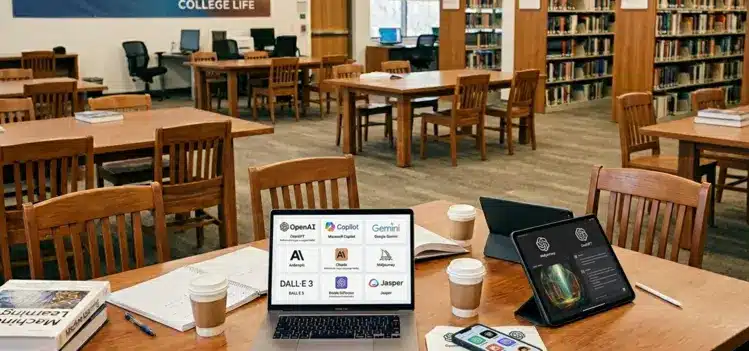
Higher education has been through fundamental shifts in recent years. Conventionally, college students competed with their peers. The emergence of ChatGPT in 2023 ushered a new era in which students compete with, and alongside, large language models. It is safe to emphasize this reality.
Initially, dean’s officers perceived the technology as a digital plague. However, they have gradually moderated their views. AI is no longer a “cheat code.” The symbiosis possible when using it makes it a foundational utility rivalling fundamental features such as the library database or high-speed internet. However, there is a need to balance the consequent era of unprecedented productivity with concerns over the resultant minefield of academic integrity and cognitive atrophy. Every stakeholder is increasingly recognizing that navigating college life today requires more than technical skill; it requires a new kind of “AI literacy.”
The Opportunity: AI as the Ultimate "Research Concierge"
The most significant opportunity for 2026 students lies in Synthesis over Search. In the past, a nursing student working on a PICOT question (Population, Intervention, Comparison, Outcome, Time) would spend hours filtering through PubMed/MEDLINE and Cochrane. Today, AI-driven research assistants can ingest five hundred PDFs and identify the thematic gaps in under ten minutes. Expectedly, the scope of work that students cover has to evolve to accommodate these developments.
How to Pivot:
Colleges cannot escape the realities of the AI revolution. The revolution is forcing students to transition from being “Information Gatherers” to becoming “Information Architects.” Logically, AI can be suitable basis of building the conceptual framework of your research. The student can use the framework to write the paper.
- Prompt Engineering for Logic: In academic writing, consider using AI to stress-test your arguments. For instance, you can query the AI model as follows: “Here is my thesis on digital transformation in airport facilities—what are the three most likely counter-arguments a skeptical professor would raise?”
- The “Study Twin” Method: Upload your lecture notes and ask the AI to quiz you using “Active Recall” techniques. This usage would transform a passive reading session into an interactive, high-retention study block.
The Challenge: The "Human-in-the-Loop" Integrity Standard
Institutions of higher learning have shifted to “Multimodal Assessment” as AI becomes more invisible. Colleges are increasingly reducing the weight of take-home essays. Instead, they are shifting to oral defenses, in-class proctored writing, and “Process Documentation.”
The Challenge of Detection:
As you clearly know, plagiarism is a central concern in academic writing. The battle between AI writers and AI detectors has reached a stalemate. Colleges have to change their assessment approaches. It is necessary to shift attention from passing AI detection to ensuring students maintain a unique intellectual voice. LLM will replace those who cannot differentiate their writing from AI.
The Response:
- Voice Fingerprinting: In your writing, always include personal anecdotes, specific classroom discussions, or localized data. For instance, give attention to your local laws or practices that an AI would not naturally prioritize.
- The Paper Trail: Keep every draft. The “burden of proof” lies on the student whenever a paper is flagged. The most effective defense is to have copies illustrating organic growth of your ideas.
Career Preparedness: The "AI + Human" Hybrid Worker
As you prepare for your career, remember the value of leverage that a worker gains when using a tool. A tool can enable one person to do then work of ten. Unfortunately, the looming question in every college campus is: “Will AI take my job before I even graduate?” Whether you are in an MBA program or a Nursing specialty, the answer is the same: AI will not take your job, but those using it better than you might. AI will multiply your value if you know how to use it.
Emerging Opportunities:
- The “Prompt-to-Product” Skillset: Companies in 2026 are looking for “AI Orchestrators.” This means knowing how to use AI to generate a rough Forex trading strategy, but then using your own technical analysis skills to verify the Volume Spread Analysis (VSA) and Fair Value Gaps (FVG) manually.
- Soft Skills as “Hard” Assets: As AI handles the quantitative (the data, the math, the coding), the market value of “Human” skills has skyrocketed. Empathy in nursing, leadership in management, and ethics in research are now the “un-automatable” premiums.
The Mental Health Crisis: "Efficiency Anxiety"
The “Standard of Excellence” has shifted because AI allows students to produce work faster. What used to be an “A” paper now requires more depth because AI tools have raised the “baseline”. This leads to a phenomenon called “Efficiency Anxiety”—the feeling that if you are not using every second to optimize your output, you are falling behind.
The Response:
- Cognitive Offloading vs. Cognitive Atrophy: Be intentional about what you outsource. Never outsource the critical thinking bit of writing. Be the one to form conclusions or evaluate the ethics of a given topic. You can however outsource tasks such as formatting citations or summarizing long transcripts.
- Digital Fasting: Set boundaries. Successful students will be those who can still think deeply without a screen. Reading a physical book or writing by hand strengthen focus.
How ScholarlyWritings.com Bridges the Gap
In this complex environment, students often find themselves paralyzed between the “old way” and the “AI way.” At ScholarlyWritings.com, we represent the third path: Postgraduate Human Expertise.
While AI can give you a “statistically probable” answer, it cannot provide the lived experience of a nursing professional who has spent 1,000 hours in a cardiac ward, or an MBA who has navigated real-world supply chain disruptions.
Our Role in Your Journey:
- Expert Synthesis: We provide the “Human-in-the-Loop” polish that AI lacks. Our writers ensure your research is not just “accurate,” but that it resonates with the specific academic culture of your institution.
- Technical Verification: AI often “hallucinates” data or citations. Our team performs manual verification of every source, ensuring that your PICOT nursing question or SPSS data analysis is rooted in verifiable reality.
- Mentorship, Not Just Content: We help students understand the why behind the grades. Our service acts as a high-level academic consultancy, helping you tackle the challenges of 2026 academia with confidence.
Conclusion: The Era of the "Augmented Student"
The AI revolution in college life is a reality to be lived in. The students who thrive in 2026 will be those who view AI as a tool that makes them faster. However, exploiting its power requires they develop competence.
Do not let the LLM models overwhelm your education. Wisely use AI for the mundane tasks, but retain your human touch to achieve a masterpiece. And when the academic pressure becomes a barrier to your growth, remember that professional, human-led support is just a click away at scholarlywritings.com.
Are you ready to elevate your academic game in the age of AI?
👉 [Partner with the Experts at ScholarlyWritings.com] — Where postgraduate insight meets modern academic strategy. Let us help you navigate your thesis, your data, and your future with precision.

Need help with research paper writing?
March 24, 2026