 Skip to content
No products added!
Category
Date Posted
June 16, 2026
/
No Comments
Mastering Clinical Questions: PICO vs. PICOT in Nursing Research
In modern healthcare, Evidence-Based Practice (EBP) serves as the foundation for safe, high-quality patient care. Nursing professionals must actively seek, critically appraise, and integrate the best available clinical evidence to guide clinical decision-making (Bourgault et al., 2025).
Clinical research frameworks help streamline literature searches in large databases such as PubMed, CINAHL, and the Cochrane Library. Among the most widely used frameworks are PICO and PICOT, two tools designed to help formulate focused, searchable nursing research clinical questions.
Although PICO and PICOT appear nearly identical at first glance, they can influence literature searches, research design, and the practical application of findings in different ways.
This guide explains the key differences between PICO and PICOT, provides practical nursing examples, and helps you select the most appropriate framework for your literature review, evidence-based practice project, or academic assignment.
PICO vs PICOT: Quick Comparison
PICO and PICOT are structured EBP frameworks used in evidence-based nursing research to formulate searchable clinical questions. The primary difference between them is that PICOT includes a Timeframe (T) component.
PICO | PICOT |
Primary Focus: Identifying relationships between clinical variables | Primary Focus: Evaluating relationships within a defined timeframe |
Focuses on the core clinical elements of a problem | Includes all PICO elements plus a defined timeframe |
Best for literature searches or exploratory research | Best for specific clinical trials, quality improvement projects, and capstone studies |
Does not specify when outcomes are measured | Defines when outcomes will be measured or evaluated |
Searches a wider body of evidence | Produces more targeted and time-specific evidence |
While the two EBP frameworks help clinicians formulate focused clinical questions, PICOT adds a timeframe component that can significantly influence study design, evidence retrieval, and outcome evaluation.
The Driving Need for Structured Frameworks in EBP
Structural frameworks matter so much in nursing research because healthcare environments are inherently complex and fast-paced. When a bedside nurse notices a spike in hospital-acquired infections or a nurse leader wants to reduce burnout on a medical-surgical floor, the initial problem statement is often broad and messy.
A vague question like “How can we stop patients from getting pressure ulcers?” is too massive to search effectively. It provides no clear parameters for a database algorithm to return precise results.
Structuring a clinical problem transforms broad curiosity into a focused, searchable research question.
This transformation minimizes bias, eliminates irrelevant search results, saves hours of aimless scrolling, and ensures that the eventual literature review relies on high-quality, reproducible science.
Defining the Frameworks: The Anatomy of a Clinical Question
Both PICO and PICOT are mnemonic devices designed to isolate the variables of a clinical scenario. They break down a multifaceted problem into distinct, searchable concepts that can be linked together using Boolean operators (AND, OR, NOT) in academic databases (Hosseini et al., 2024).

The Core Components (PICO)
Every PICO question consists of four foundational pillars that define the clinical ecosystem of your study:
- P – Patient, Population, or Problem: This defines the specific group of individuals, demographic, or disease state you are investigating. Precision is vital here to ensure your findings are clinically applicable. Instead of just searching for “patients,” a nursing researcher might specify “adult patients undergoing open-heart surgery,” “premature neonates experiencing neonatal abstinence syndrome,” or “community-dwelling elderly individuals over the age of 75.”
- I – Intervention or Indicator: This represents the primary action, treatment, therapy, diagnostic test, or exposure you want to evaluate. In nursing, interventions often extend far beyond medications or surgical procedures. They frequently encompass independent nursing actions, such as “hourly proactive rounding,” “prone positioning protocols,” or “structured phone-based follow-up.”
- C – Comparison or Control: This is the alternative option against which your primary intervention is measured. It serves as the baseline to prove the actual effect of the new intervention. The comparison could be the current hospital standard of care, a placebo, no intervention at all, or a completely different treatment strategy.
O – Outcome: This is the measurable, clinical, or behavioral result you hope to achieve, prevent, or improve. Outcomes must be completely objective and quantifiable. Vague goals like “patients feel better” do not work. Instead, nursing research requires specific targets like “a 15% reduction in pressure injury rates,” “decreased 30-day readmission percentages,” or “reduced length of ICU stay measured in days.”
The Temporal Addition (PICOT)
The PICOT framework takes the same four pillars in the PICO framework and appends a crucial fifth element that grounds the entire inquiry in real-world time:
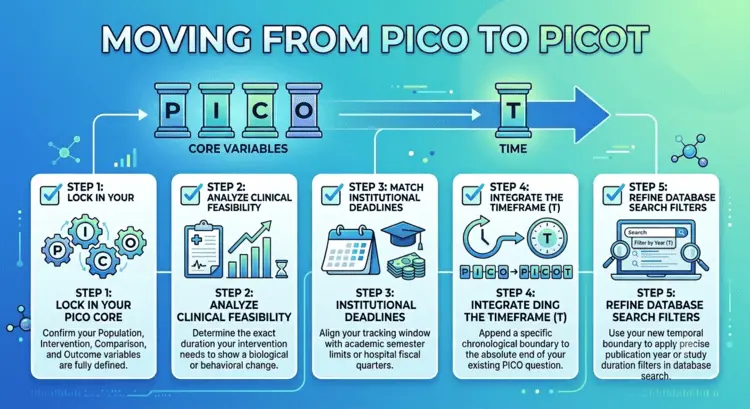
- T – Timeframe: This specifies the exact duration or period over which the intervention will be implemented, or the specific window during which the outcome will be tracked and evaluated. Time (T) can represent either the duration of the intervention (e.g., 6 months) OR the specific time point when data is gathered (e.g., at 48 hours post-op). Thus, PICOT is a variation of PICO helpful for studies evaluated over a period of time (University of the West of Scotland (UWS), n.d.). It anchors the clinical question to a chronological boundary, turning an abstract clinical idea into a highly structured chronological plan.
💡 Struggling to Align Your Research Variables?
Writing a flawless PICO or PICOT question is often the hardest part of any nursing research paper. If you are stuck trying to isolate your population, intervention, or comparison, you do not have to struggle alone. The doctoral-level nursing writers at ScholarlyWritings.com can help you refine your variables, build custom database search strings, and lay a rock-solid foundation for your literature review.
The Critical Difference: Why Time Matters in Nursing Methodology
The explicit inclusion of the Timeframe (T) is the sole structural variance between PICO and PICOT, but has profound impact on nursing research, data gathering, and project execution (Eldawlatly et al., 2018). In clinical environments, time directly dictates biological healing, behavioral compliance, institutional resource allocation, and overall data validity.
1. Database Search Precision and Filter Calibration
When searching databases like CINAHL, PubMed, or Medline, a PICO question casts an incredibly wide net. It retrieves any study comparing the intervention and control, regardless of whether the trial lasted two weeks, six months, or ten years. While this is helpful for broad synthesis, it can return thousands of irrelevant articles (Tucker et al., 2023).
Adding a specific timeframe (PICOT) drastically narrows your search parameters. If your question explicitly targets outcomes measured “within 30 days post-discharge,” you can safely filter out or skip long-term longitudinal studies that might track patients for five years. This saves valuable time during the screening phase of a systematic review.
2. Project Scope, Feasibility, and "Scope Creep" Prevention
Nursing research often takes the form of Quality Improvement (QI) projects, evidence-based hospital initiatives, or academic capstones (such as BSN, MSN, or DNP projects). You have to complete them within academic semesters or institutional fiscal quarters.
A PICOT question grounds your research in this time reality. Specifying a timeframe establishes clear operational boundaries that fit neatly into an academic or professional deadline.
3. Accounting for Biological and Behavioral Nuances
Many nursing interventions require time to show efficacy. For instance, evaluating the impact of a plant-based diet on a patient’s A1C levels requires a minimum of three months due to the lifespan of red blood cells. Conversely, testing a rapid-acting non-pharmacological pain intervention (like ice therapy) requires tracking outcomes in minutes or hours.
PICOT ensures that the study’s design aligns perfectly with human physiology and behavioral psychology.
PICO vs. PICOT: Side-by-Side Clinical Scenarios
To fully grasp how the presence or absence of a timeframe alters a research focus, let us look at three distinct clinical scenarios across different nursing specialties.
Scenario 1: Acute Care / Critical Care Nursing
- The Baseline Problem: An ICU nursing unit wants to evaluate methods to reduce ventilator-associated pneumonia (VAP) because their current rates are higher than the national benchmark.
- PICO Formulation: In mechanically ventilated adult patients (P), does the use of chlorhexidine mouthwash (I) compared to standard saline mouthwash (C) reduce the incidence of ventilator-associated pneumonia (O)?
- Analysis: This question is excellent for a general literature review. It seeks to establish a broad causal link between oral care types and infection rates across all existing medical literature, regardless of how long the patients were intubated.
- PICOT Formulation: In mechanically ventilated adult patients (P), does the use of chlorhexidine mouthwash (I) compared to standard saline mouthwash (C) reduce the incidence of ventilator-associated pneumonia (O) within the first 48 hours of intubation (T)?
- Analysis: This question is highly specific. It targets early-onset ventilator-associated pneumonia, helping an ICU nursing team determine the superior oral care type to protect patients during the most critical initial window of mechanical ventilation.
Scenario 2: Maternal-Child / Pediatric Nursing
- The Baseline Problem: A postpartum unit wants to improve breastfeeding exclusivity rates among first-time mothers.
- PICO Formulation: For primiparous postpartum mothers (P), does early skin-to-skin contact in the delivery room (I) compared to standard newborn warming protocols (C) increase successful exclusive breastfeeding rates (O)?
- Analysis: This looks broadly at the relationship between immediate postpartum bonding and breastfeeding success.
- PICOT Formulation: For primiparous postpartum mothers (P), does early skin-to-skin contact in the delivery room (I) compared to standard newborn warming protocols (C) increase successful exclusive breastfeeding rates (O) at the 6-week postpartum follow-up visit (T)?
- Analysis: Adding the six-week mark allows the researcher to see if the immediate delivery room intervention creates a lasting behavioral impact that persists well after the patient has been discharged from the hospital environment.
Scenario 3: Community Health / Chronic Disease Management
- The Baseline Problem: A clinic wants to know if telehealth can help geriatric patients manage high blood pressure.
- PICO Formulation: In geriatric patients diagnosed with primary hypertension (P), do nurse-led telehealth check-ins (I) compared to standard outpatient care (C) improve medication adherence (O)?
- Analysis: This question explores the general utility of telehealth. It is helpful for understanding if technology-driven nursing interventions work in a broad, abstract sense across various past studies.
- PICOT Formulation: In geriatric patients diagnosed with primary hypertension (P), do nurse-led telehealth check-ins (I) compared to standard outpatient care (C) improve medication adherence (O) over a continuous 6-month period (T)?
- Analysis: Chronic disease management relies heavily on long-term behavioral changes. By defining a six-month window, the researcher can evaluate if the telehealth intervention has lasting power or if patient engagement drops off after the initial novelty wears off.
📝 Stuck on Your Literature Review?
Once you have your PICO or PICOT framework, the next step is locating, reading, and synthesizing dozens of peer-reviewed articles. This process takes immense time and dedication. If your deadline is approaching, let ScholarlyWritings.com take the burden off your shoulders. We provide comprehensive literature synthesis, matrix creation, and high-level academic writing tailored to nursing curriculum standards.
Strategic Guide: When to Choose PICO vs. PICOT
Selecting the appropriate tool depends entirely on the nature of your assignment, your institutional goals, and where you currently stand in your overall research journey.
Feature / Dimension | PICO Framework | PICOT Framework |
Primary Focus | Fundamental clinical relationships and variables. | Variable relationships constrained by real-world time. |
Best Used For | Broad literature reviews, scoping reviews, exploratory research. | Capstone projects, DNP project proposals, Quality Improvement (QI). |
Search Volume | Returns a massive, comprehensive pool of data. | Narrow, highly targeted, and streamlined results. |
Project Planning | Conceptual; establishes what works. | Operational; establishes when and how long it works. |
Choose PICO When:
- You are conducting an exploratory review: If you are diving into a rare disease state or a brand-new nursing technology with limited existing literature, keeping the time element open ensures you do not accidentally filter out valuable pilot studies.
- Time is a static or irrelevant factor: Some clinical interventions yield immediate, permanent results where tracking a duration adds unnecessary complexity to your search string (e.g., comparing two types of needleless connectors to prevent immediate catheter occlusions).
- Writing short conceptual essays: For undergraduate nursing assignments that only require a basic exploration of an EBP concept, a PICO question provides plenty of depth without overcomplicating the search parameters.
Choose PICOT When:
- You are executing a Quality Improvement (QI) project: Hospital leadership and financial boards want to know exactly when they will see returns on investment or measurable drops in complication rates. A PICOT question outlines the precise implementation and evaluation window for institutional change.
- You are writing a Capstone, Thesis, or DNP Project: High-level academic projects operate on rigid schedules. Defining your timeframe helps you realistically map out your data collection phase, ensuring your academic goals align with your actual calendar.
- Evaluating progressive conditions or behavioral habits: For diseases where outcomes naturally fluctuate over time, anchoring your question with a specific timeline keeps your data clean, reliable, and scientifically sound.
Synthesizing Frameworks into Academic Success
PICO and PICOT advance evidence-based practice in nursing. Neither of these EBP frameworks is inherently superior to the other. Rather, they serve different strategic purposes depending on your clinical or academic context. PICO provides a flexible, robust foundation for exploring broad clinical relationships, while PICOT injects a layer of real-world precision necessary for targeted interventions and structured institutional projects.
Matching clinical goals to the correct framework helps streamline literature review, protect the project from scope creep, and contribute high-value, actionable insights to the nursing profession.
🎓 Achieve Academic Excellence with ScholarlyWritings.com
Balancing 12-hour nursing shifts, clinical rotations, family life, and demanding academic writing assignments can feel nearly impossible. If you are struggling to keep up with your BSN, MSN, or DNP research requirements, let our nursing professional writers help. At ScholarlyWritings.com, we specialize in delivering custom, plagiarism-free, premium nursing research papers, capstone proposals, and EBP projects designed to help you succeed.
You will get a premium, fully customized nursing research paper.
Frequently Asked Questions (FAQ)
What is the main difference between PICO and PICOT?
The primary difference is that PICOT includes a Timeframe (T) component, while PICO does not. Both frameworks help formulate focused nursing research clinical questions, but PICOT specifies when outcomes will be measured or evaluated. This additional element makes PICOT particularly useful for quality improvement projects, clinical trials, and evidence-based practice initiatives where timing influences outcomes.
Is PICOT better than PICO?
No. PICOT simply adds a timeframe and is most useful when duration matters.
When should nursing students use PICO?
PICO is most appropriate for broad literature reviews, exploratory research, and situations where the timing of an intervention or outcome is not critical. It allows researchers identify relationships between clinical variables without restricting the search to a specific evaluation period. Nursing students commonly use PICO when conducting initial evidence searches or developing research topics.
How does PICOT improve research?
By including a specific timeframe, PICOT can make literature searches more focused and efficient. The timeframe helps researchers identify studies that evaluate outcomes within a defined period, reducing irrelevant results and improving the relevance of the evidence retrieved. This is especially beneficial for capstone projects, quality improvement initiatives, and evidence-based practice studies.
Can a PICO or PICOT question be used for a nursing capstone project?
Yes. Both EBP frameworks can be used for nursing capstone projects, but PICOT is often preferred because it incorporates a timeframe that helps define implementation and evaluation periods. This makes it particularly useful for evidence-based practice and quality improvement projects.
References
Bourgault, A. M., Davis, J. W., LaManna, J., Turnage, D., & Conner, N. E. (2025). A crosswalk analysis of commonly used evidence-based practice models. International Journal of Nursing Practice, 31(4). https://doi.org/10.1111/ijn.70034
Eldawlatly, A., Alshehri, H., Alqahtani, A., Ahmad, A., Al-Dammas, F., & Marzouk, A. (2018). Appearance of population, intervention, comparison, and outcome as research question in the title of articles of three different anesthesia journals: A pilot study. Saudi Journal of Anaesthesia, 12(2), 283–286. https://doi.org/10.4103/sja.SJA_767_17
Hosseini, M.-S., Jahanshahlou, F., Akbarzadeh, M. A., Zarei, M., & Vaez-Gharamaleki, Y. (2024). Formulating research questions for evidence-based studies. Journal of Medicine, Surgery, and Public Health, 2, Article 100046. https://doi.org/10.1016/j.glmedi.2023.100046
Tucker, S., Edmonds, S. W., Cullen, L., Hanrahan, K., & Laures, E. (2023). The problem with PICO for finding the best evidence: Fishing with the wrong bait and the SEARCH solution. Journal of PeriAnesthesia Nursing, 38(5), 809–812. https://doi.org/10.1016/j.jopan.2023.07.002
University of the West of Scotland. (n.d.). Formulating a research question: PICO/PICOT/PICOS. https://uws-uk.libguides.com/c.php?g=730595&p=5326895

Everlyn M.
Everlyn is a seasoned academic writer and researcher with over 5 years of experience helping students succeed through custom-written nursing essays and research papers. She specializes in guiding students through the complexities of academic writing.
June 16, 2026